Life with New Dentures: Navigating the Physical & Emotional Transition
Congratulations on your new dentures! Transitioning to a full set of dentures is a major life event. It is helpful to think of your new dentures as prosthetic limbs for your mouth. Just as you would have to learn how to walk with a new prosthetic leg, you must retrain your mouth to eat, speak, and smile.
The first few weeks are a "Learning Phase." Here is what you can expect and how to succeed.
What to Expect in the First 7 Days
When you first put your dentures in, your brain and mouth will have a brief "disagreement" as they adjust to a foreign object.
The "Mouthful of Marbles" Feeling: You may feel like your lips are pushed out or your tongue has no room. This is normal until your facial muscles learn to relax.
Excess Saliva: Your mouth thinks the dentures are food and will produce extra saliva. This usually settles within a few days.
The Gag Reflex: Some patients feel a "gagging" sensation, especially with the full upper denture.
Pro-Tip: Focus on breathing slowly through your nose. Sucking on a sugar-free mint can also help distract your nerves.
Why Your Dentures Feel "Loose" or Unstable
Unlike natural teeth (or partial dentures anchored to existing teeth), full upper and lower dentures "float" on your gums.
The Upper vs. Lower Challenge: The full upper denture uses suction against the roof of your mouth and is usually quite stable. The full lower denture is much trickier; it relies on gravity and your tongue/cheeks to hold it down.
The Lower Base Reality: It is important to be accurate: there is never actual suction on a full lower denture. It is easily mobilized by speech and facial expressions, which pull on the muscles and tendons connected directly under the base of the lower denture. It will feel looser than the top—this is expected.
The "Seesaw" Effect: Because the denture is one solid piece, pressure on one side can cause the other side to lift.
The Muscle Learning Curve: Right now, your tongue and cheeks are trying to "push" the denture out. Over several weeks, they will learn to wrap around the denture to hold it in place instead.
The "Floating" Tongue: Every time you move your tongue to clear food, you might accidentally "tip" the lower denture out of place. This settles as the tongue adapts to its new environment.
Learning to Eat and Speak Again
Speaking: Certain sounds—specifically "S," "F," "Th," and "V"—will be tricky for all denture wearers. You may lisp or whistle.
The Fix: Read out loud or sing in the shower. If the denture slips while talking, a quick, gentle swallow will help reseat it by creating a momentary vacuum.
Eating: Stick to soft foods (eggs, yogurt, fish) for the first week.
The Rule for Full Dentures: Unlike natural teeth fixed into bone or partial dentures anchored to existing teeth, full dentures are simply placed upon a surface. Avoid biting into anything with your front teeth (like an apple), as this will break the seal and pop the back of the denture loose.
Bilateral Chewing: For all denture wearers, practice chewing on both sides of your back teeth at the same time. This distributes pressure evenly and prevents the denture from tipping or "rocking."
Physical Changes and Bone Loss
Once natural teeth are gone, the jawbone naturally begins to shrink (resorb).
Healing Phase: If you had teeth extracted recently, your gums will shrink significantly over the first 6 months.
The Result: A denture that fit perfectly on day one may feel loose by month three. This is why professional relines (refitting the inside of the denture) are a standard and necessary part of the process for all full denture wearers.
Sore Spots and Maintenance
Adjustments: As your gums settle, small "hot spots" or ulcers may develop. Do not attempt to file the denture yourself. Call us for an adjustment.
Tip: Wear the dentures for at least 2 hours before your appointment so we can see exactly where the rub is occurring.
Cleaning: For all dentures (full and partial), brush daily with a soft-bristle brush and mild detergent and water. Always clean them over a sink filled with water or a towel—if they drop on a hard floor, they will break.
Rest Your Gums: Never sleep in your dentures. Your gums need 6–8 hours of oxygen and blood flow to stay healthy and prevent infection. Store them in plain water overnight.
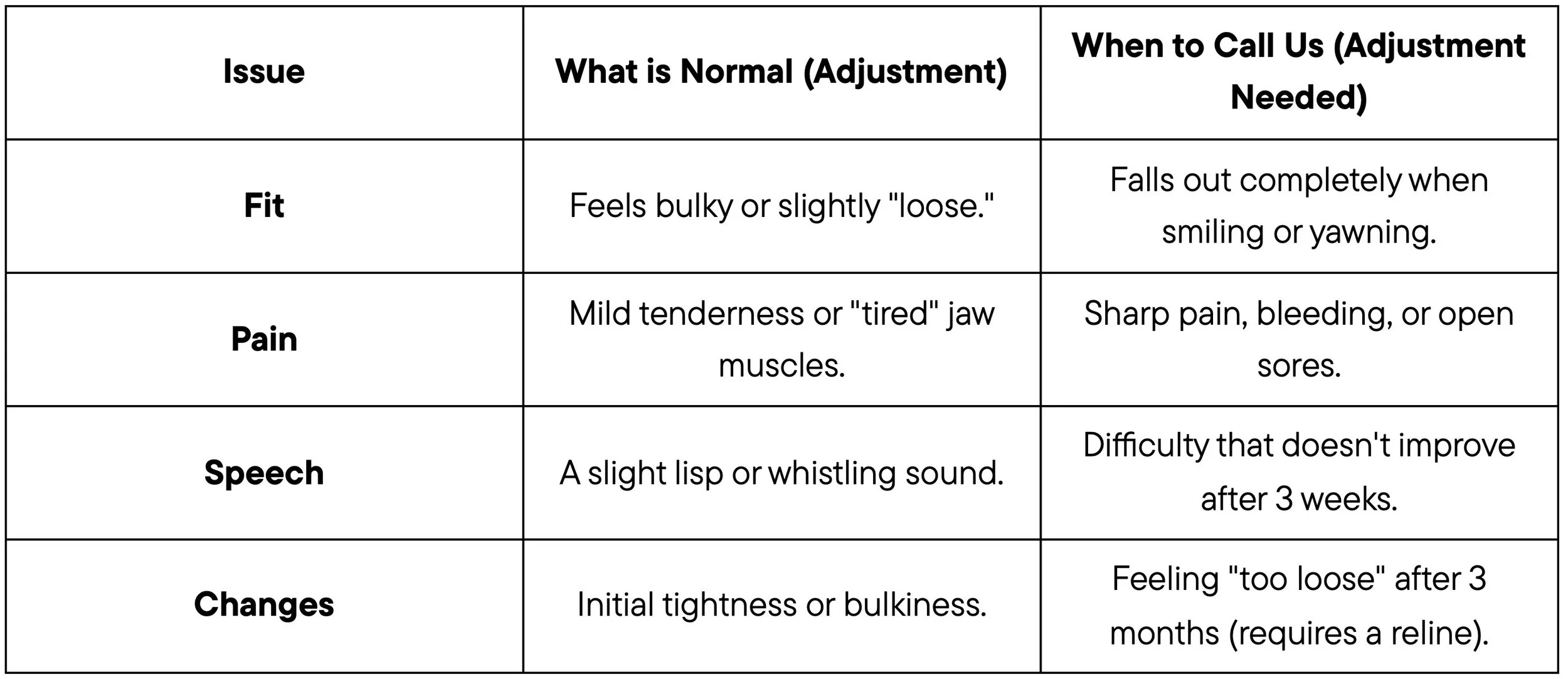
Troubleshooting Table: Normal vs. Concerning
Pro-Tips for Success
Adhesives: Think of denture adhesive as "training wheels." Use a small amount to boost your confidence while your muscles are still learning.
Rest Your Gums: Always take your dentures out at night. Your gum tissue needs oxygen and blood flow to stay healthy.
Patience: Most patients report that it takes about 30 days to feel truly comfortable and 6 months to feel like the dentures are a natural part of their body.
Our blog is full of expert advice and information designed to help you make informed decisions. Take a look at our other articles to discover more.